OpenAI Is Building an AI Smartphone — Mass Production by 2028
OpenAI is developing its own AI-first smartphone targeting mass production in 2028, partnering with Qualcomm and MediaTek on custom silicon and working with Jony Ive on design. Specs will be finalized by late 2026.

Aman Yadav
Staff Writer
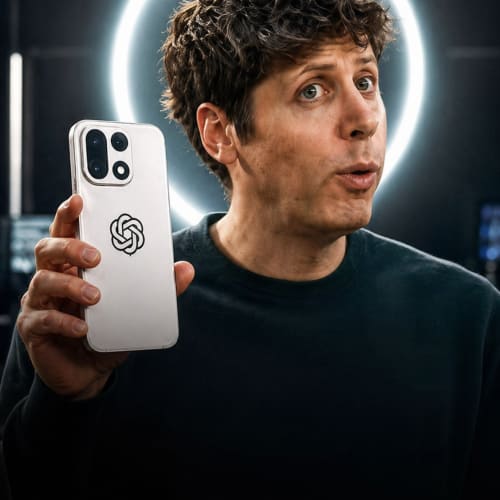
OpenAI's rumored AI smartphone would represent a radical departure from traditional app-based interfaces, prioritizing AI agents over the traditional app grid.
OpenAI isn't just building AI software anymore—it's building an entire phone around it. Supply chain analyst Ming-Chi Kuo reports that the company is developing a smartphone targeting mass production in 2028, marking OpenAI's boldest hardware play yet.
This isn't a ChatGPT app slapped onto Android. According to Kuo's latest intelligence, OpenAI is collaborating with chipmakers Qualcomm and MediaTek to develop custom processors optimized specifically for AI agents. Luxshare, the same manufacturer that handles Apple's most delicate assembly lines, will serve as the exclusive system co-design and manufacturing partner.
The Architecture: A Phone Built for Agents, Not Apps
The traditional smartphone interface—the app grid—has dominated consumer electronics for 16 years. OpenAI is betting that era is ending. Rather than a collection of individual apps, the company envisions an operating system where the primary interface is a conversational AI agent that understands intent and autonomously completes tasks.

"Users are not trying to use a pile of apps. They are trying to get tasks done and fulfill needs through the phone. This fundamentally changes how people think about smartphones." — Ming-Chi Kuo, Analyst
To pull this off, the hardware needs to be different. The chipsets being developed with Qualcomm and MediaTek will prioritize memory hierarchy and power efficiency for always-on context awareness. The phone needs to "understand" who you are before you even speak—which demands a completely different silicon architecture than what powers current iPhones and Androids.
The Timeline: Late 2026 for Specs, 2028 for Launch
OpenAI isn't rushing. Key specifications and suppliers are expected to be finalized by late 2026 or early 2027. Mass production would then begin in 2028, targeting the high-end smartphone segment (roughly 300-400 million units annually).

That timeline matters. For comparison, Apple typically spends 18-24 months between finalizing specifications and commercial launch. OpenAI's timeline is aggressive but not unprecedented—and it gives them roughly two years to perfect both hardware and software integration.
The company is also enlisting design legend Jony Ive, the former Apple Chief Design Officer who shaped the iPad, iPhone, and Apple Watch. Ive, who now runs the design firm LoveFrom, is collaborating with OpenAI on the physical product. The implication is clear: this won't look like a typical AI prototype or a generic Android phone. It will be a consumer product designed from the ground up.
Why This Matters for OpenAI
OpenAI faces a critical problem. Apple just selected Google's Gemini as the default intelligence layer for iPhones and the revamped Siri—relegating ChatGPT to secondary status. Losing default placement on 2 billion Apple devices was a major strategic defeat.
Building its own hardware solves this problem entirely. A proprietary OpenAI phone means:
- Default integration with GPT and its latest models
- Direct user relationships and data
- Revenue bundling (hardware + subscription)
- An ecosystem for AI agents
- Escape from dependence on Apple, Google, or Microsoft ecosystems
It's the nuclear option, but it's not unprecedented. Google built Pixel to promote Android and Gemini. Apple built the Mac around macOS. Hardware gives you control—not just of the software, but of how millions of people experience it.
The Risks Are Real
Hardware is unforgiving. Google Glass flopped hard. The Humane Pin generated headlines and lawsuits. Building phones requires capital, supply chain expertise, and manufacturing precision that OpenAI has never attempted.

The company will also be competing against Apple's two-trillion-dollar market cap and Google's distribution advantage. Even with Jony Ive's design pedigree and custom silicon partners, execution risk is massive.
But here's what makes this plausible: OpenAI doesn't need to outsell the iPhone. It just needs to build a viable consumer product that keeps users inside its AI ecosystem. If even 5% of premium smartphone buyers choose an OpenAI phone over alternatives, that's roughly 15-20 million units annually—enough to sustain a hardware business and turn AI agents into a primary platform.
The Bigger Picture
This move signals that the AI industry has matured beyond software. OpenAI, Google, Apple, and others are now building the physical infrastructure through which billions will interact with artificial intelligence. The smartphone industry is about to get very interesting.
If OpenAI can deliver on this timeline and vision, 2028 could mark the beginning of the post-app era—where a conversational AI agent, not an app grid, is the primary interface between humans and the digital world.
For now, though, the company is staying quiet. All we have is supply chain whispers and a target date: 2028. But based on past performance from analyst Kuo, who famously predicted the Apple Watch before anyone else, those whispers are worth taking seriously.
The race for AI supremacy just entered the hardware phase. And OpenAI is betting big.
About the Author

Aman Yadav
Covering the latest in AI, technology, and business — built for the modern Indian tech reader.
Related Stories

AI Is Using Your Job. But It's Not Taking It — Microsoft's Global Report Changes the Narrative

13 Balls. 8 Sixes. Joint-Fastest Fifty Ever. Meet Urvil Patel — CSK's New Weapon
